# About Ways of Making

144 exercises drawn from an archive of more than 500 clips about creativity and technology.

## Origin

- Steve Sharp shared clips as @contemporary.blueprint for two years.
- The archive contains more than 500 clips and continues as Artificial Milieu.
- Ways of Making turns ideas from the archive into exercises for your own work.

## Inside a Way

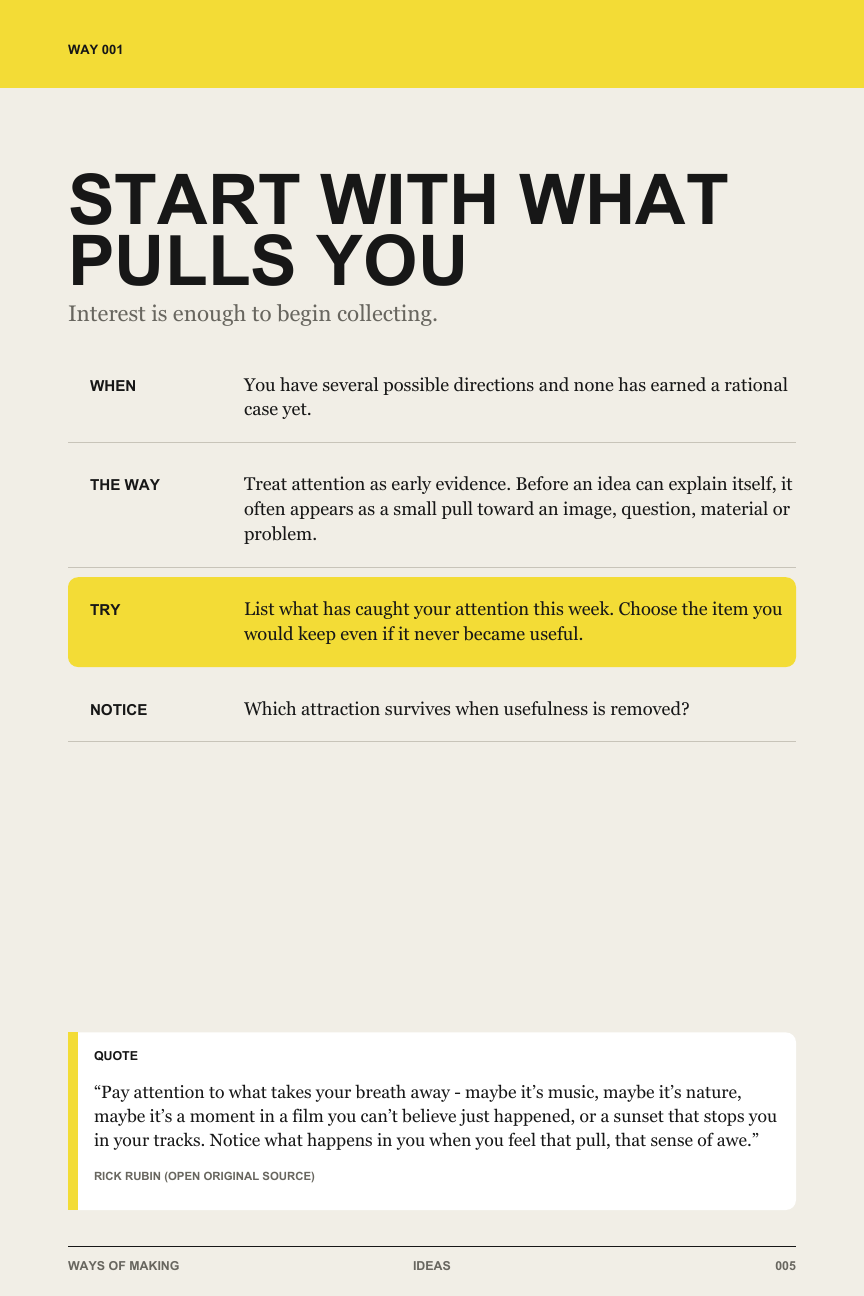
- When: The situation in which the Way may help.
- The Way: An approach to bring to the work.
- Try: A specific exercise you can apply to your own work.
- Notice: A question to help you judge the result.
- Example: One way someone might apply the exercise.
- Reference quote: A condensed passage and link to the source clip.

## Reference note

Reference quotes are condensed from the linked clips, so the wording is close to what was said. Check the clip before quoting. Artificial Milieu wrote the title, explanation, exercise and example. These are applications, not methods written or endorsed by the speaker.

## Name

Ways of Making is inspired by John Berger’s Ways of Seeing. The random draw is inspired by Brian Eno and Peter Schmidt’s Oblique Strategies.

## Publisher

Steve Sharp · @steveobserves · Artificial Milieu
Where these come from
Exercises for making your next attempt.
Ways of Making turns an archive about creativity and technology into 144 exercises you can apply to your own work.
Use the book on its own. AI is optional.

144Ways
3editions
500+clips in the archive
12Ways in the free book
From an archive to something you can use.
For two years, I shared clips about creativity and technology as @contemporary.blueprint. I saved the video and transcript of each post, building an archive of more than 500 clips. That work continues as Artificial Milieu.
I made Ways of Making to turn that archive into something you can use when your own work needs a different approach. These 144 exercises give you a specific action to try and a question to help you judge the result. Bring a stalled draft or an idea you haven't tried. Choose a Way and use it to make your next attempt.
Context, an exercise and a question.
Each Way gives you enough context to try an exercise and decide what to keep.
Browse the public WaysWays of Making
Anatomy of a Way
- 01When
The situation in which the Way may help.
- 02The Way
An approach to bring to the work.
- 03Try
A specific exercise you can apply to your own work.
- 04Notice
A question to help you judge the result.
- 05Example
One way someone might apply the exercise.
- 06Reference quote
A condensed passage and link to the source clip.
How a reference becomes a Way.
Artificial Milieu wrote each title, explanation, exercise and example. These are applications, not methods written or endorsed by the speaker.
- 01
Begin with the archive
A reference passage supplies the idea behind each Way.
- 02
Write an exercise
Artificial Milieu turns that starting point into a specific action someone can try.
- 03
Show one application
An example makes the exercise easier to adapt to another piece of work.
- 04
Keep the source visible
The reference passage names the speaker and links to the clip.
References
Close to what was said.
Each reference quote is condensed from the linked clip, so the wording is close to what was said. Check the clip before quoting.
Publisher
Artificial Milieu
The archive began as @contemporary.blueprint and continues as Artificial Milieu. The speakers did not write or endorse the Ways.
Visit Artificial MilieuWays of Seeing, then Ways of Making.
The name Ways of Making is inspired by John Berger's Ways of Seeing. The option to draw a Way at random is inspired by Oblique Strategies, the card deck Brian Eno and Peter Schmidt created in 1975.
Steve Sharp
@steveobserves
Begin with the free download
Twelve Ways to try.
Receive the Twelve Ways book, twelve printable cards and optional AI and Markdown files. The separate Working with Ways companion comes with paid editions.